QuantLink AI · ML Platform

Pick data, pick a target: get models you can trust.

AutoML Workbench is a no-code platform for training, ranking, explaining and deploying many scikit-learn, XGBoost and LightGBM models across five problem types. Kanav led it from August 2026, taking a ported research ML library and turning it into an end-to-end production platform: leakage-safe validation, explainability, ensembles, scoring, and the release and QA discipline behind them.

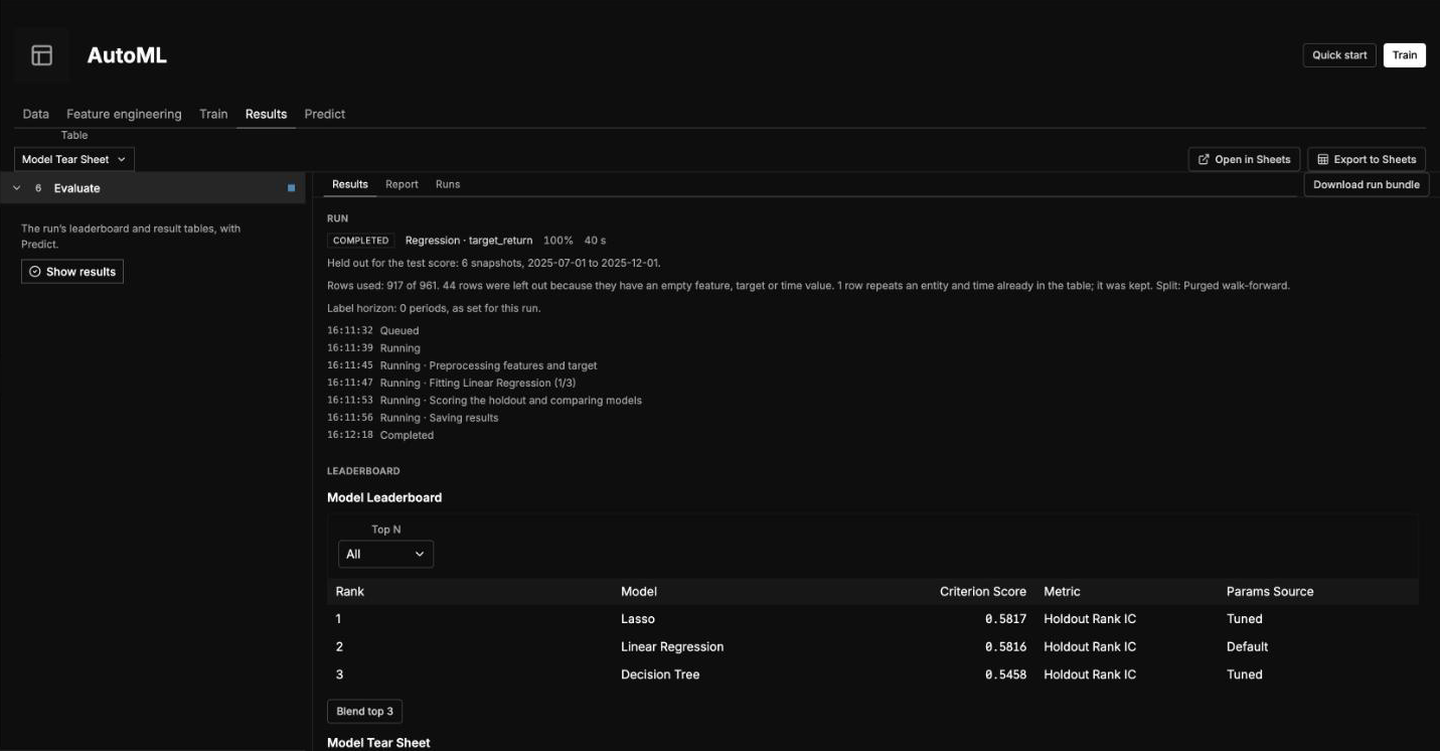
AutoML Workbench results tab showing a completed regression run with streamed progress steps, a six-date holdout, purged walk-forward split, and a model leaderboard ranked by holdout Rank IC with a Blend top 3 button
Results: streamed run progress, a row-accounting receipt, and a leaderboard ranked on a multi-date holdout, one click from a blended ensemble.
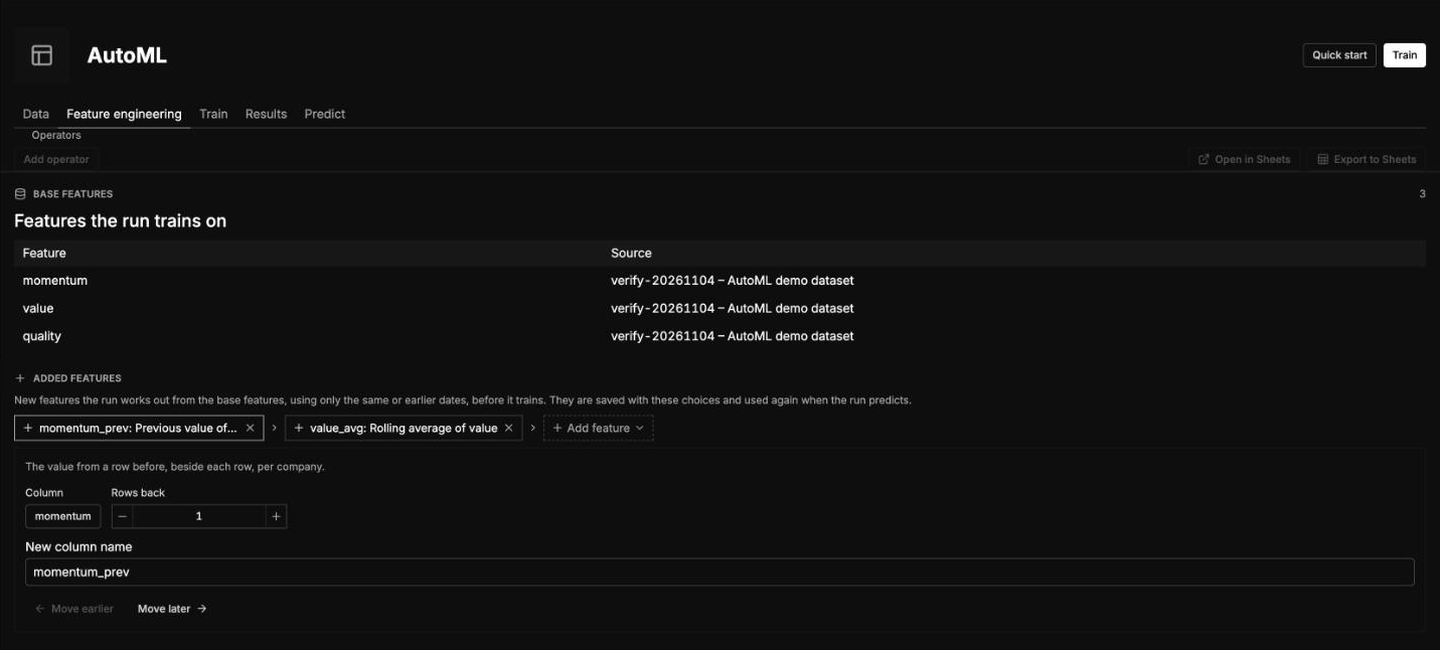
Feature engineering tab in AutoML Workbench adding a one-row lag of momentum and a rolling average of value to the base features
Feature engineering: past-only lags and rolling features, saved with the run and replayed at prediction time.
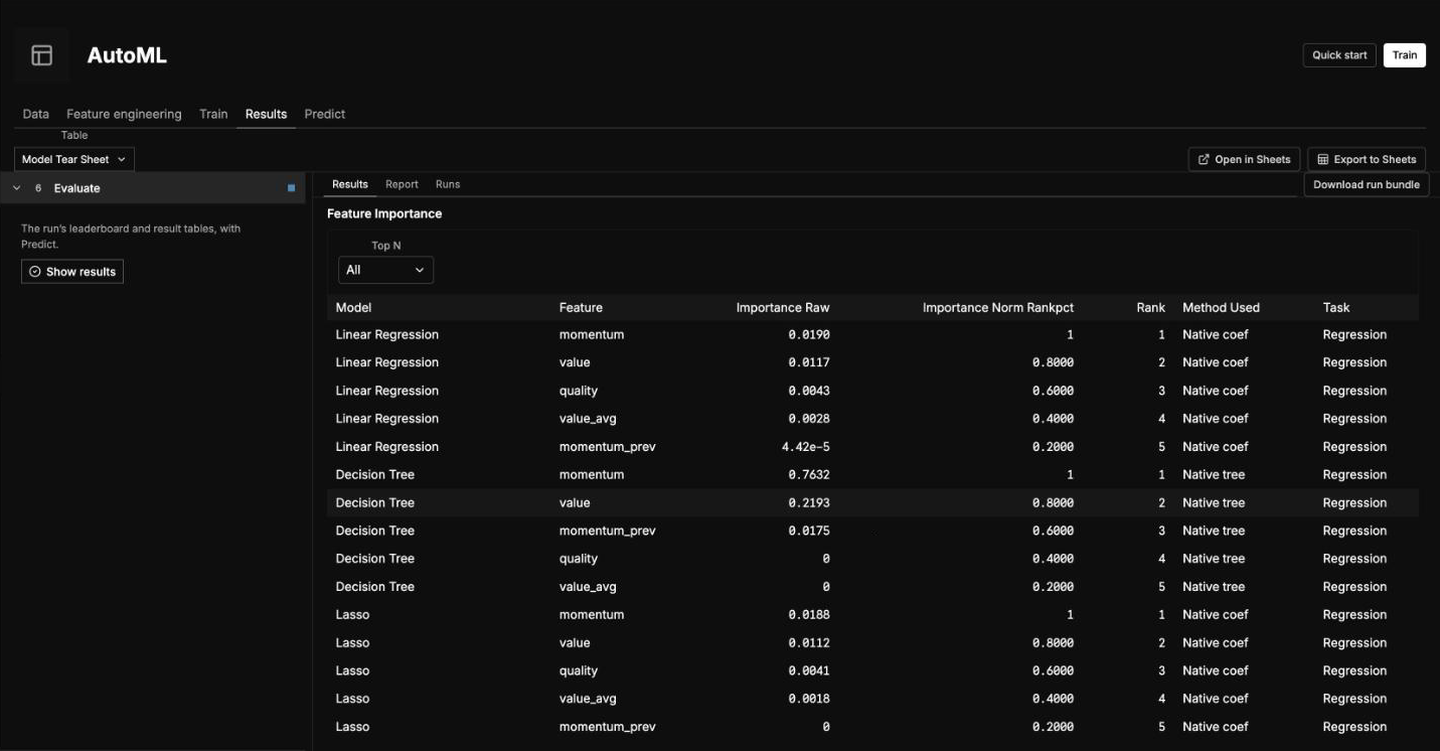
Feature importance table in AutoML Workbench comparing ranked feature importances across linear regression, decision tree and lasso models
Feature importance: per-model rankings in the user's own column names, engineered features included.

Scores that never see the future.

On financial panels, an honest score is the whole product, so leakage protection is built into every split, not left to the user.

  • Purged walk-forward cross-validation with an embargo, plus a multi-date holdout, for time-ordered data; seeded grouped or stratified K-fold for plain tables, chosen automatically from the data's roles.
  • Leakage protection proven, not assumed: a positive-control test plants a deliberately leaky column and confirms the pipeline catches it.
  • Panel leaderboards rank on holdout Rank IC IR (Spearman IC mean over its standard deviation across dates), the metric a quant desk actually trades on; plain tables rank on R² or balanced accuracy.

From raw table to explained, deployable model with no code.

Benchmarked against a commercial AutoML product, then closed the highest-value gaps: SHAP drivers, blending, holdout scoring and Quick start.

  • Quick start trains seven fast models in one click; hyperparameter search runs under a budget with early stopping; past-only lags, changes and rolling features plus sector/size neutralization are built in.
  • Every run ships a report, model tear sheet, feature importance, per-row SHAP prediction drivers, "Blend top N" ensembles and out-of-fold predictions, all exportable to sheets or a zip bundle.
  • Predict scores the latest or an as-of snapshot, or queues scoring of every row; live progress streams over SSE, and the same engine is callable from notebooks and the in-product AI agent.

Built to refuse loudly, never fail silently.

Shipped in production releases behind a staff feature flag, with the engineering discipline of a platform, not a prototype.

  • Spec-driven engine: algorithms, limits, defaults and user-facing wording live in versioned JSON specs (one consolidation removed ~20K lines), and 31 plain-language error codes keep jargon away from users.
  • Set the policy, applied across 438 data limits, that every cap is a named refusal and never a silent cut; a Redis/RQ worker pool refuses work rather than losing it, and per-dataset access rights are re-checked on every read and export.
  • Cut four reproducible engine releases (pinned commit, wheel sha256) with additive, backward-compatible API contracts across five codebases, validated by a 5-tester staging pass and a 31-item divergence audit that unified two workflows into one.