Notebook to product
Research code becomes a product with no rewrite.
A competitive audit of 16 tools (Hex, marimo, Panel, Mercury, Quarto, Voilà and more) shaped the v2 design, which was planned, implemented and merged across six codebases in about two days.
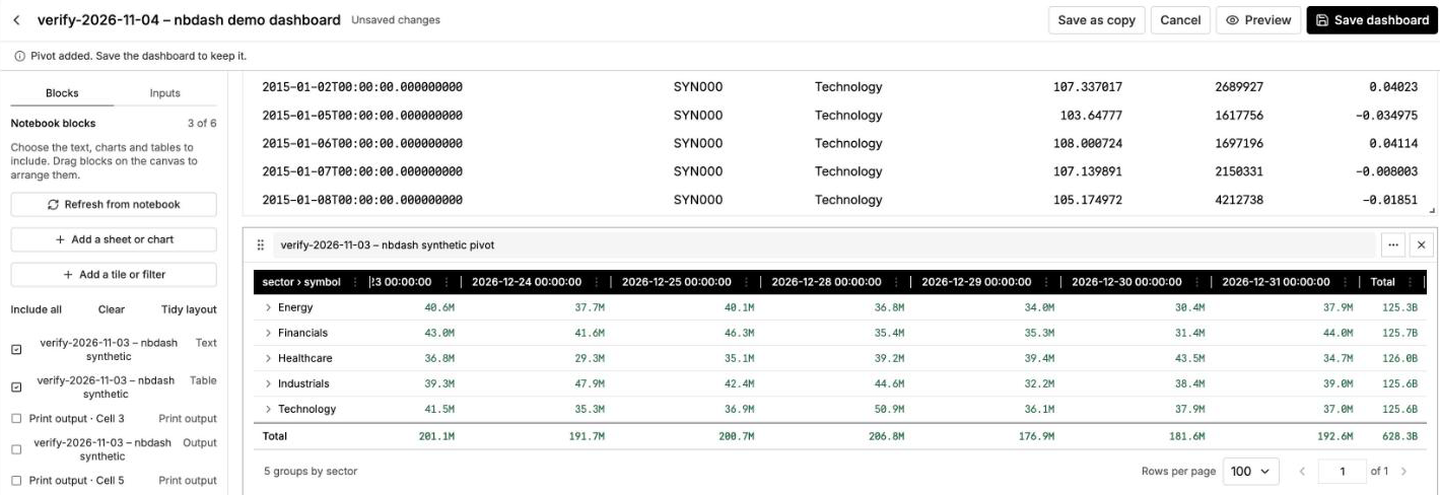
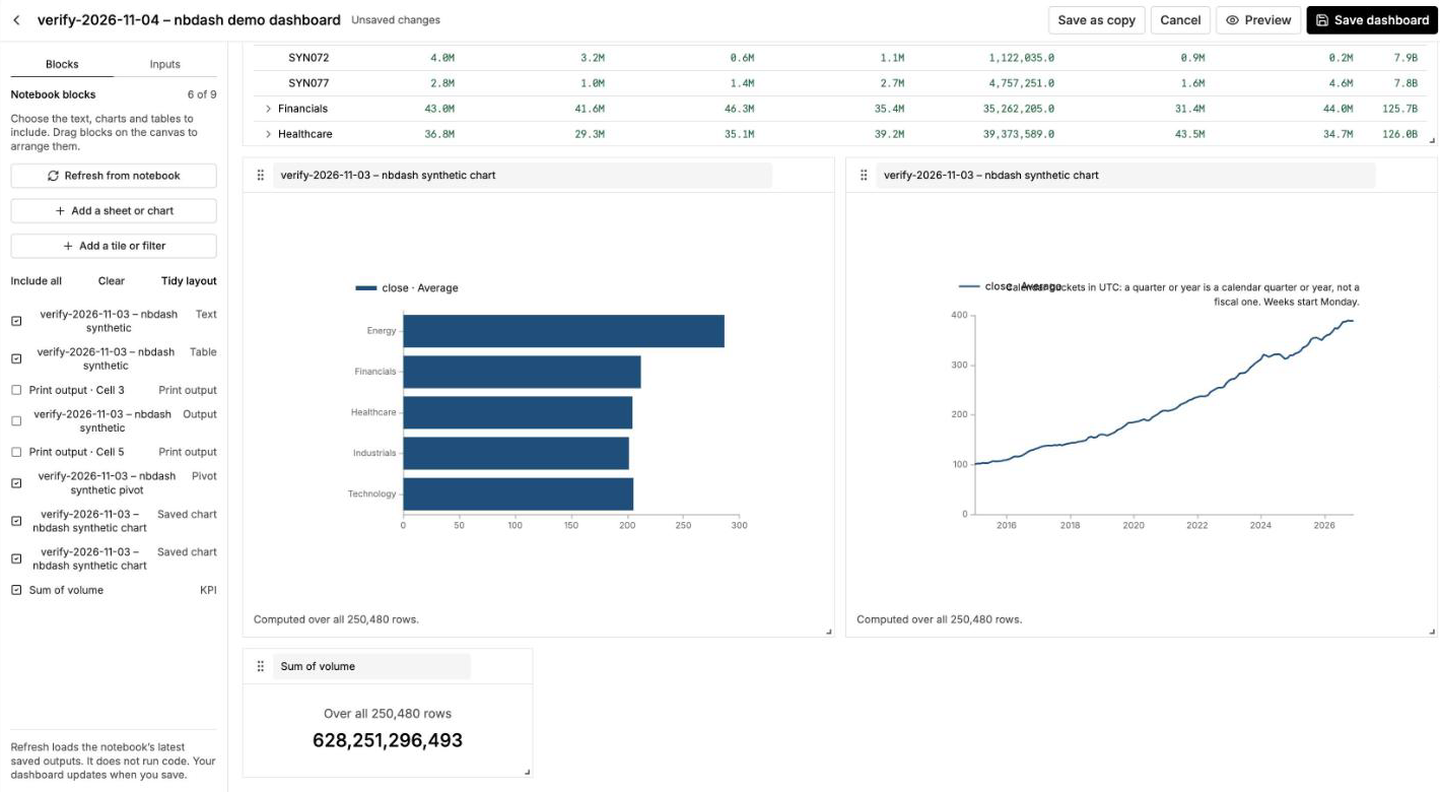
- "Create dashboard" lifts a notebook's outputs onto a drag-and-resize 12-column grid to arrange, hide, preview, save as a copy, or refresh from the notebook without touching code.
- Nine typed inputs (integer, number, text/select, date, boolean, symbols, range, date range, multi-select) are inferred from the notebook's own literals; each rerun executes in an isolated kernel with per-cell progress and swaps fresh outputs into the existing tiles.
- Cron schedules with timezones and fixed inputs, auto-paused after three failures; Explore tiles add pivots with server-side subtotals, chart, KPI and text tiles, tabs, a filter bar and chart-click cross-filtering, alongside live spreadsheet and saved-chart embeds.
- Sharing grants with owner-only runs: viewers read cached results, never execute code.
Scale & honest limits
Every row counted, every limit named.
Large DataFrames are staged as Parquet (up to 50M rows) and served through Arrow streams, so paging, sorting, search and filters cover the full dataset, not a sample.
- Third-party pivot engines were evaluated and rejected over licensing and security concerns and replaced by an in-house, spec-driven pivot and chart engine on DuckDB.
- A worst-case query that compiled for 28 s, peaked at 10.8 GiB and built 615 MB of JSON in Python was re-engineered: streamed DuckDB-written answers, cancellable compilation, and deterministic float aggregation so paging stays stable.
- One versioned limits spec (94 keys) generates Python, TypeScript and SQL for every consumer, hashed so all services agree; under a "highest limit that works" policy, every cap is measured, documented and refused by name, never silently truncated.
- Heartbeats, stale-run detection, idempotent automatic retry (including runs interrupted by deploys), bounded worker permits, and compare-and-swap publication, so a run never overwrites a newer edit.
Proven end to end
Checked against hand-computed answers.
Verification went beyond green builds: the system was audited against its own requirements and then stress-tested on a real research workload.
- A five-tester round: a 265-check view-query suite, plus 140 requirements and 58 review items audited against what actually shipped; every aggregation matched a hand-computed answer.
- Capstone: a full seven-tab stock research page (overview, financials, options with gamma exposure and a 3D implied-volatility surface, DCF modeling, filings, holders, news) rebuilt as a dashboard of 68 page elements.
- The rebuild exercised the platform end to end, from the UI down to SEC XBRL financial-statement derivations: fiscal quarters on 53-week years, TTM, EBITDA, and de-cumulated year-to-date figures.